
Conservation of the Alcatrazes frog, Scinax alcatraz: an island endemic
Scinax alcatraz is a tree frog, endemic to Alcatrazes Island and is listed as “Critically Endangered” on the International Union for the Conservation of Nature (IUCN) Red List. Part of the island belongs to the Brazilian Navy, and it is used as a target practice by navy ships. This practice often causes spot fires on the island and consequently destroys the bromeliads, the habitat of the S. alcatraz. For this reason, the establishment of an ex situ breeding program, as well as maintaining a viable population in captivity, is really necessary and urgent for the conservation of this species.
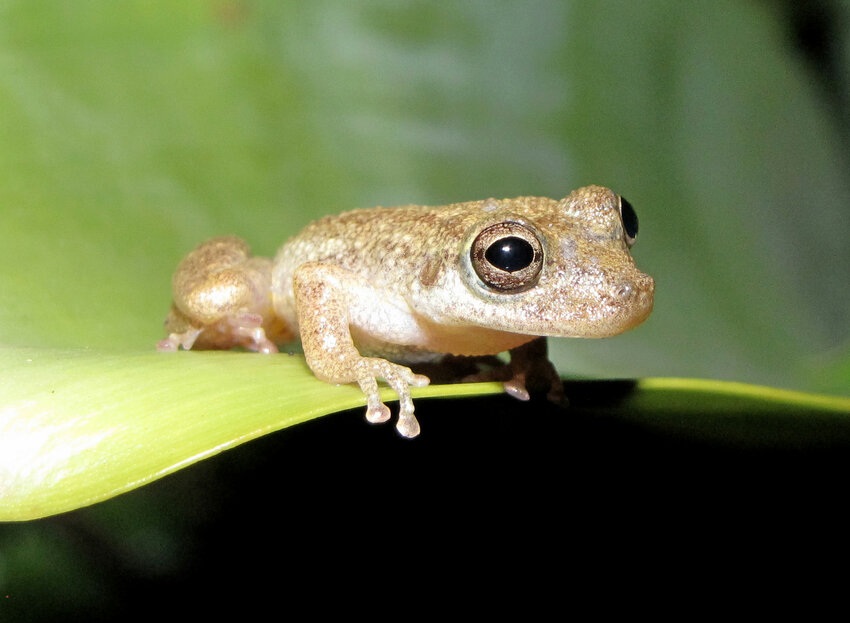
Scinax alcatraz (Lutz, 1973) is a tree frog of the perpusillus group (Hylidae family), whose life cycle is restricted to bromeliads. These treefrogs are endemic to Alcatrazes Island and are listed as “Critically Endangered” on the International Union for the Conservation of Nature (IUCN) Red List.
Habitat and threats of Scinax alcatraz
Alcatrazes Island, with an area of 135ha, is the main island of Alcatrazes Archipelago. Part of the archipelago is inserted in the Tupinambás Ecological Station (SP), under the current administration of ICMBio (Instituto Chico Mendes de Conservação da Biodiversidade - ChicoMendes Institute for Biodiversity Conservation). However, part of the island belongs to the Brazilian Navy and is used as a training target by Navy ships. This training can lead to fires on the island—it has happened in the past, burning 25% of the vegetation of the island—that can destroy the bromeliads, the habitat of the S. alcatraz, thereby decimating their entire population.
Measures to minimize the impact during the training season were agreed between the researchers and the Brazilian Navy, but the only way to eliminate this major threat to this population is to completely end this practice. At the same time, researchers have been discussing changing the status of an Ecological Station into a National Park. This categorical change would imply an increase in restrictions regarding protection, limit the use of the island, and increase the size of the protected area.
Due to the endemism of this species (restricted to Alcatrazes Island), the tree frog is susceptible to several other threats that can easily decimate the population, like natural disasters or the introduction of new diseases. For all of these reasons, the establishment of an ex situ breeding program, as well as maintaining a viable population in captivity, is becoming extremely necessary.
Moreover, what intensifies the urgency of this conservation program is the historic use of the island by the Brazilian Navy as a shooting target, which is performed exactly in the location where the species has been found so far.
Brazil's first ex situ program for amphibian species
S. alcatraz has never been kept in captivity, and for that reason, we developed a prior study with a surrogate tree frog named Scinax perpusillus, which is common in the wild and found in the Atlantic forest in the continental portion. The husbandry and reproduction of this common tree frog have proved successful, and the skills acquired during this process (2 years) can now be applied to this threatened frog.
At the same time, constant in situ monitoring of the species will be conducted to allow the investigation of possible population declines, permitting interceptive measures if needed, as well as the supplementation or even reintroduction of captive-bred amphibians. This project is based on values established by the Amphibian Ark, and will be used to promote ex situ program as a tool for conservation of a critically endangered species for which in situ measures are not enough so far.
This is the first ex situ conservation program of a frog species developed in Brazil, and the results of this project will encourage other researchers to work with different Brazilian endangered species of amphibians.
The founders will be collected during the rainy season and will be placed in a captive biosecure breeding facility (modified shipping container), inside of FPZSP facilities. The funds requested from AArk will be used for husbandry and care materials. Parallel to the captive program, constant monitoring of the species will be conducted to enable the research of possible population declines, and if necessary, the genetic and sanitary viable population of Scinax alcatraz maintained in captivity will be ready for some possible supplementation or reintroduction. The results of this project will be processed in a guideline, which can be used to make the amphibian conservation a priority in public policies in Brazil.
Related publications:
Lisboa CS, Vaz RI, Brasileiro CA. 2021. Captive breeding program for Scinax alcatraz (Anura: Hylidae): introducing amphibian ex situ conservation in Brazil. Amphibian & Reptile Conservation 15(2) [General Section]: 279–288 (e293).