
New IUCN Resolution highlights the urgency for amphibian conservation financing, action, and the role of ex situ measures
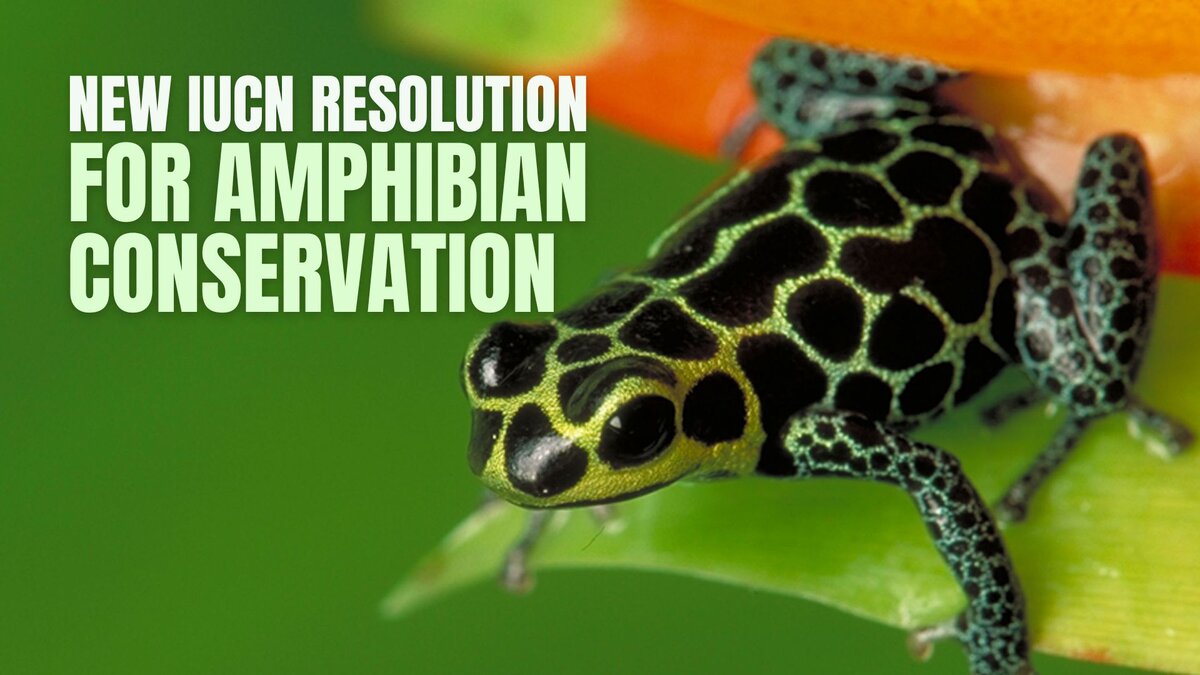
At the 2025 IUCN World Conservation Congress, held in Abu Dhabi this October, members approved Motion 075 guiding the global response to the amphibian extinction crisis. This resolution underscores the urgent need for governments and donors to step up with coordinated action and long-term investment to prevent further amphibian extinctions.
Despite decades of work, the second Global Amphibian Assessment (Luedtke et al. 2023) revealed sobering trends: 41% of amphibian species are threatened with extinction, 37 are confirmed extinct, and climate change has emerged as an additional driver alongside habitat loss, disease, and exploitation. This pattern varies among regions and species but paints a worrying picture overall (State of the World’s amphibians).
The new resolution, drafted by Re:wild and Synchronicity Earth, reviewed by members and experts in the IUCN SSC Amphibian Specialist Group (ASG), Conservation Planning Specialist Group (CPSG), Amphibian Ark (AArk) and Amphibian Survival Alliance (ASA), and submitted by Synchronicity Earth, aligns with the 2024 Amphibian Conservation Action Plan (ACAP), which provides a framework for regional and national action. This resolution calls for:
- Governments to prevent amphibian extinctions by investing in long-term, country-level implementation of the IUCN Assess-Plan-Act framework; protect Key Biodiversity Areas and other habitats important for amphibians; and continue to promote the regulation and monitoring of species involved in trade.
- Donors to provide sustainable support and funding to the SSC and its amphibian conservation partners.
- The collaboration of the SCC and the scientific community with others to update and develop guidelines on key topics of relevance to amphibian conservation, including measures for amphibians impacted by climate change, management of disease in the wild, appropriately sized natural reserves, and other thematic issues as required.
We also call upon the Director General of the IUCN, the Species Survival Commission, non-governmental organizations, donors, and the scientific community to support governments in exercising their full responsibilities to achieve Targets 1, 3, and 4 of the Kunming-Montreal Global Biodiversity Framework, which include acting to prevent amphibian extinctions and support their recovery through long-term country-level investment in the Assess-Plan-Act framework of the IUCN.
Amphibian Ark and ex situ conservation
Around 25% of threatened amphibian species require ex situ conservation. For Amphibian Ark, the new IUCN resolution acknowledges the essential contribution and need of effective ex situ programs to amphibian recovery. Since 1980, ex situ measures have helped decrease the extinction risk of 63 amphibian species, and nearly 100 additional threatened species are now being maintained in assurance colonies.
Since our founding in 2007, Amphibian Ark has worked closely with zoos, aquariums, and field partners worldwide to establish and support ex situ programs, and to train institutions and conservationists in the effective management of species in urgent need of rescue. We will continue to assist these teams and species as needed, collaborating through the Amphibian Coalition to prioritize species and conservation actions, strengthen capacity where it is most needed, and sustain ex situ initiatives through our grants, network, and other resources.
“The IUCN’s call to action comes at a critical moment,” said Jonathan Wilcken, Executive Director of Amphibian Ark. “Many amphibians are teetering on the brink of extinction. As the most threatened of all vertebrates, they need urgent support. By urging governments and funders to step up, the IUCN is drawing welcome attention to one of the world’s most pressing conservation crises.”
For more details:
You can read more in our recent publication on Oryx magazine here.
Find the approved IUCN Motion 075 here. This motion was submitted by Synchronicity Earth, and co-sponsored by the following organizations: Re:wild (USA), Zoological Society of London (UK), PROVITA (Venezuela), New Mexico BioPark Society (USA), Durrell Wildlife Conservation Trust (UK), Mandai Nature Fund Ltd (Singapore), Wildlife Trust of India (India), Herp Conservation Ghana (Ghana), FUNDAECO- Fundación para el Ecodesarrollo y la Conservación (Guatemala).
