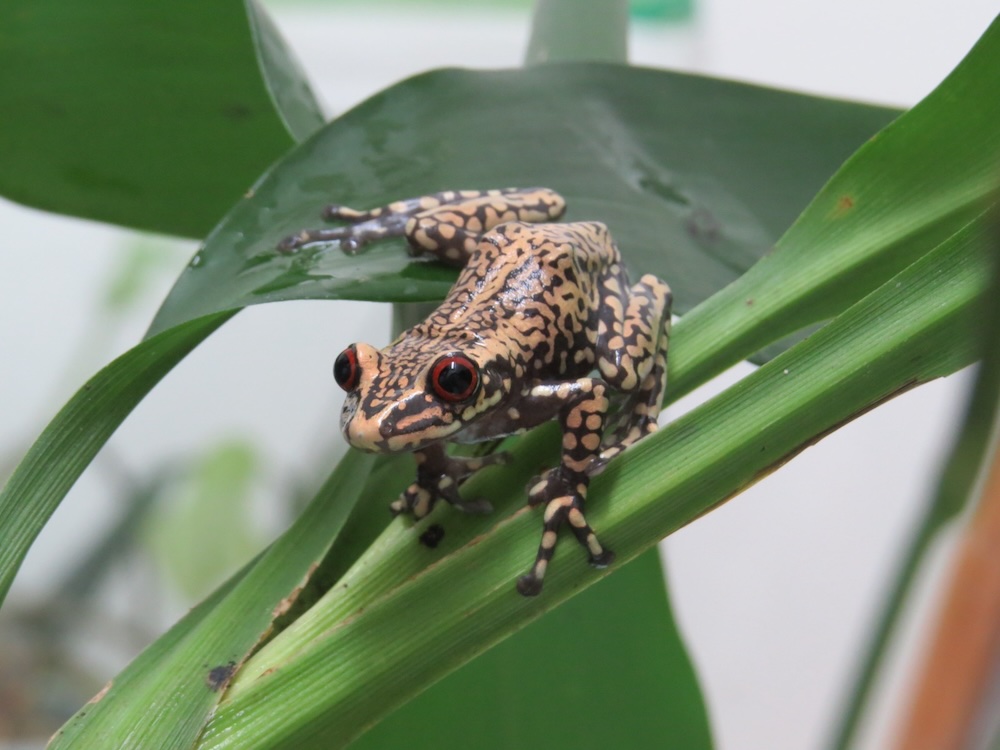
Conservation of the casque-headed frog, Nyctimantis pomba: an ex situ story
Nyctimantis pomba is a critically endangered tree-frog from Brazil, endemic to a small and non-protected fragment of Atlantic Forest (1.36km²), with legal problems and highly impacted by farming activities. It is a very rare species and field researchers believe it will be extinct in a few years if nothing is done.
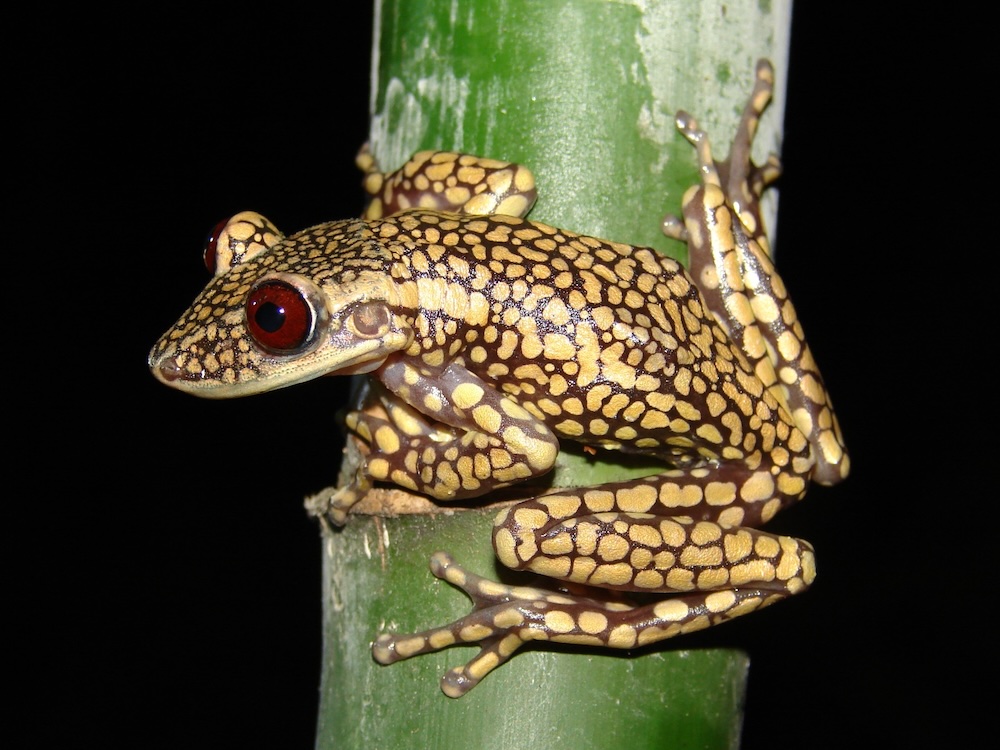
2019 Grantee: Cybele Lisboa, Cauê Monticelli, and Clodoaldo Lopes Assis
Considering this scenario, the Instituto Chico Mendes para Conservação da Biodiversidade-ICMBio (federal government agency responsible for biodiversity-related issues) and the Association of Zoos and Aquariums of Brazil-AZAB, included N. pomba among the 25 Brazilian species with the highest priority to develop a captive breeding program. So far, this is the only amphibian in this list, among other vertebrates. Also, this species was evaluated by the AArk Conservation Needs Assessments tool and it is one of the high-priority amphibian species in Brazil.
In 2019, we started a conservation program to develop a captive protocol of maintenance and reproduction for this species, and to establish an ex situ back-up population in case there is a need for supplementation of the wild population. To start the program, we were provided with US$3,000 from a private donor (through Amphibian Ark), which allowed us to undertake three field trips to search for founder individuals and to purchase basic lab equipment for maintaining them.
During the last two years, we were able to collect 4 males and 2 juveniles to start the ex situ population, but we didn’t find any female yet. Until this moment, the management of the captive population is adequate, since the individuals look healthy and have never presented any problem. During field campaigns, we have obtained important information about the size of the wild population, as we have monitored it through recaptures of marked males (photo-ID). We also started researching the health of the individuals and the presence of Bathrachochytrium dendrobatidis in the wild population. Due to the COVID pandemic situation in 2020, we were not able to conduct more field campaigns. However, this was not the only challenge we have faced.
We still need to find females to allow the development of the breeding protocol and increase the captive population, which is our main goal. However, as this species is very rare, seasonal, and probably with a small population, it was not easy to find individuals. The best weather conditions are also unpredictable. All of us, team members, have other duties in our institutions that do not allow us to spend more than five days in the field, which reduces the chances of finding founders. In addition, Cybele and Cauê depend on their institution's car to travel to Cataguases municipality (622 km away) and, recently, the car has become less and less available.
In order to solve the abovementioned challenges, we applied and received an AArk Extension Grant in 2021.
2023 Updates
(You can read the full update in our March 2023 newsletter)
Fieldwork
As a first step, we decided to increase search efforts during the period of greatest activity of N. pomba. We hired three interns for daily sampling in the occurrence area, from November 16th to December 10th, 2021. This search increase was fundamental for our objectives, because for the first time, we found females and recorded a large chorus of more than twenty males calling together. This event only took place on one night and we would have missed it if the interns had not been in the field daily.
We measured and photographed all captured individuals. We also swabbed their skin to test for the presence of Bathrachochytrium dendrobatidis in the wild population. All swabbed individuals were negative. We also collected the females that which we needed as founders to start developing the captive breeding program at the Wildlife Conservation Center of the State of São Paulo (CECFAU), in Araçoiaba da Serra, Brazil.
Ex situ management
After the field campaign, the founding captive population consisted of twelve individuals (five males, four females, and three juveniles of undetermined sex). All individuals were in the managing laboratory, which had been established at CECFAU. We have continued with the same husbandry practices since 2019, which were reported in AArk Newsletter Number 49. Individuals were maintained in terrariums according to size and sex and monitored in relation to food intake and body score. We also started to collect nocturnal images using an infrared camera, which will be used to obtain data about the behavior of the species.
Our first breeding attempt occurred in December 2021, as one of the newly collected females had oocytes in her abdominal cavity. We immediately placed her in a terrarium with two males; the next day, she laid eggs in the water. Unfortunately, the eggs did not develop. We are not sure if the eggs simply weren’t fertilized or if the water conditions were not suitable for their development. During the following breeding season, in November 2022, we put male-female pairs together rather than keeping them separate until oocyte development. When the breeding season came, two females laid fertilized eggs. At the moment, several tadpoles are still developing; many have already finished metamorphosis. This marks the first time that N.pomba has reproduced in captivity!
The funding provided by Amphibian Ark allowed us to find founder animals and establish the captive population of N. pomba. This support also made it possible for us to record previously undocumented information about their reproduction in the wild, as well as to collect important population data—both of which are essential for conservation of the species in the wild. Finally, the successful breeding of N. pomba in captivity was a major step towards our goal of creating an ex situ insurance population for the species. At the end of 2022, the regional Amphibian Specialist Group of Brazil (ASG-Brazil) organized a workshop to develop a specific action plan for N. pomba. This workshop involved relevant stakeholders and utilized all of the data obtained in our study. We hope these actions will contribute to the conservation of N. pomba.
Related publications:
- ASG Brasil/IUCN SSC. 2023. Plano Estratégico de Conservação de Anfíbios (PECAn): Perereca-pintada (Nyctimantis pomba) 2023-2028.